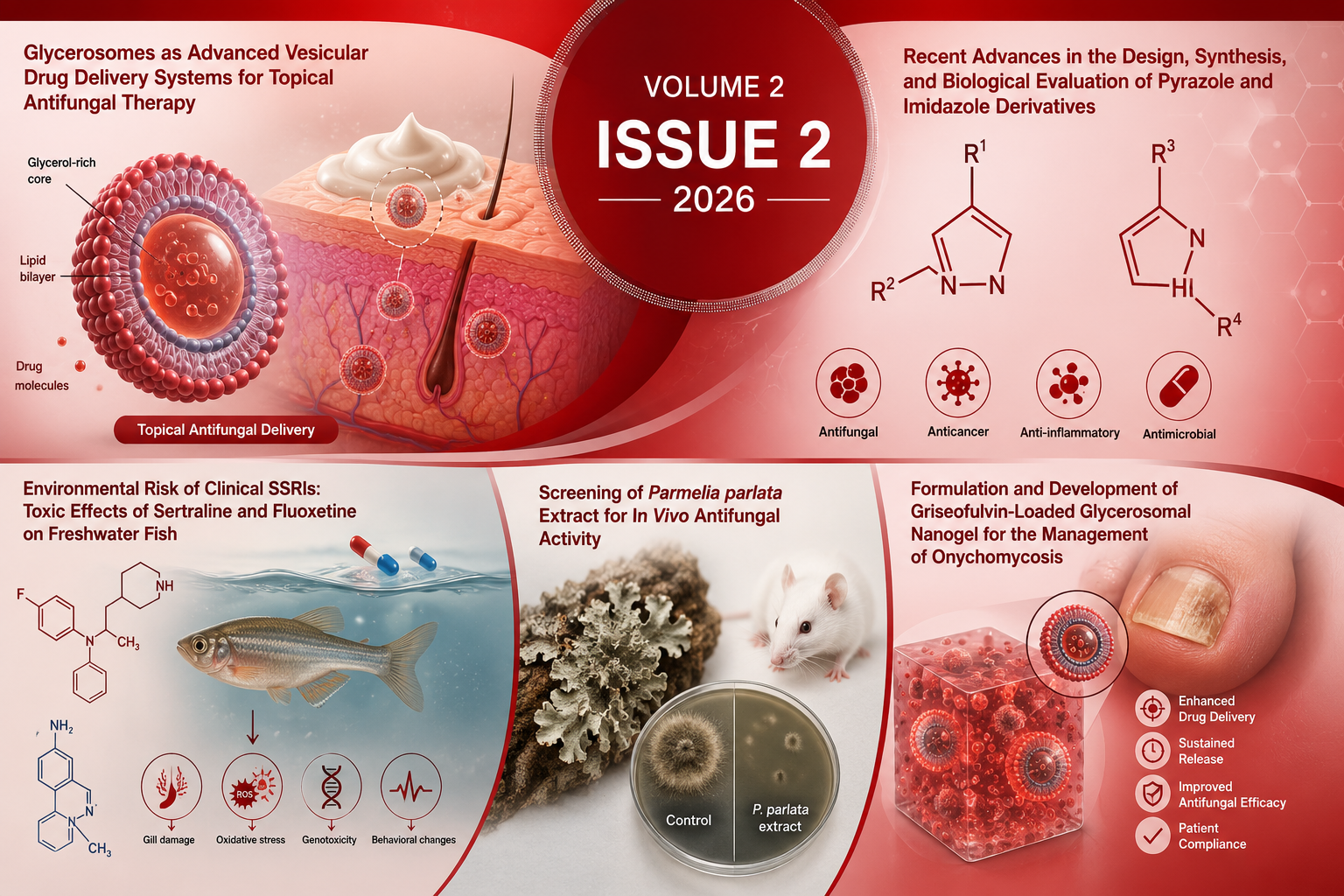
Recent Advances in the Design, Synthesis, and Biological Evaluation of Pyrazole and Imidazole Derivatives: Emerging Scaffolds in Drug Discovery and Development
DOI:
https://doi.org/10.5530/ddd.2.2.10Keywords:
Pyrazole , Imidazole, Structure activity relationship, Molecular docking, Heterocyclic Compounds, Drug Discovery, Biological EvaluationAbstract
Pyrazole and imidazole are two important nitrogen-containing heterocyclic scaffolds that have attracted considerable attention in medicinal chemistry owing to their broad spectrum of biological activities and structural versatility. These heterocycles are widely incorporated into clinically approved drugs and continue to serve as valuable frameworks for the development of novel therapeutic agents. Recent advances in synthetic methodologies, computational drug design, and biological screening have accelerated the discovery of pyrazole- and imidazole-based compounds with improved pharmacological profiles. This review comprehensively examines recent developments in the design, synthesis, and biological evaluation of pyrazole and imidazole derivatives reported in the literature. Emphasis is placed on modern synthetic approaches, including conventional and green chemistry methodologies, as well as structure-based and ligand-based drug design strategies. The pharmacological activities of these compounds, including antimicrobial, antifungal, anti-inflammatory, antiviral, anticancer, and enzyme inhibitory effects, are critically discussed. Furthermore, structure-activity relationship (SAR) studies, molecular docking investigations, and emerging computational approaches relevant to lead optimization are highlighted. Numerous pyrazole and imidazole derivatives have demonstrated promising biological activities against a variety of therapeutic targets. SAR studies reveal that strategic structural modifications significantly influence potency, selectivity, and pharmacokinetic properties. Recent advances in molecular modeling, artificial intelligence-assisted drug discovery, and hybrid molecule design have facilitated the identification of novel lead compounds with enhanced therapeutic potential. Additionally, sustainable synthetic methodologies have improved the efficiency and environmental compatibility of heterocyclic drug development. Pyrazole and imidazole derivatives remain privileged scaffolds in modern drug discovery due to their remarkable chemical diversity and broad pharmacological applications. Continued integration of medicinal chemistry, computational tools, and innovative synthetic strategies is expected to accelerate the development of safer, more effective, and target-specific therapeutic agents based on these heterocyclic frameworks.
Downloads
Downloads
Published
Issue
Section
License
Copyright (c) 2026 Priyanka Kumari, Praveen Kumar (Author)

This work is licensed under a Creative Commons Attribution 4.0 International License.