
Microbial Exopolysaccharides: Nature’s Solution to Environmental Challenges
DOI:
https://doi.org/10.5530/jam.5.3.10Keywords:
Bioremediation, Circular bioeconomy, EPS biosynthesis, Green nanotechnology, Sustainable Biopolymers, Waste water treatmentAbstract
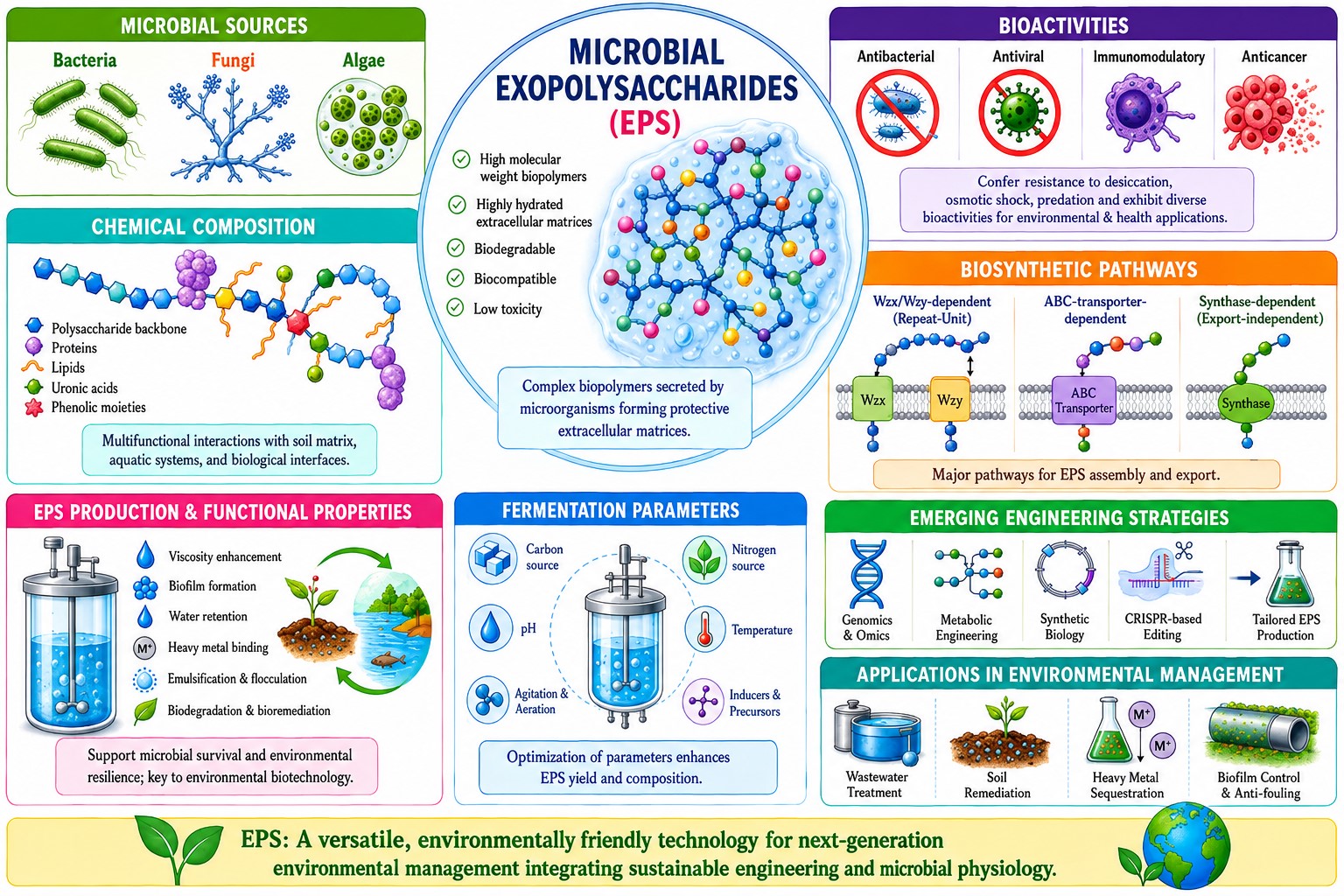
Microbial exopolysaccharides (EPS) are high molecular weight, complex biopolymers secreted by microorganisms such as bacteria, fungi, and algae. These highly hydrated macromolecules form protective extracellular matrices that confer resistance to desiccation, osmotic shock, and predation. EPS have a wide range of bioactivities, including antibacterial, antiviral, immunomodulatory, and anticancer characteristics, and their intrinsic biodegradability, biocompatibility, and low toxicity are driving increased interest in environmental biotechnology. Microbial EPS are chemically composed of polysaccharide backbones that are frequently functioning with protein, lipids, uronic acids, and phenolic moieties, allowing for multifunctional interactions with soil matrix, aquatic systems, and biological interfaces. In this article, we discuss analysis of major EPS-production, and their functional properties, discussion of the principal biosynthetic pathways (Wzx/Wzy-dependent, ABC-transporter-dependent, and synthase-dependent) and the fermentation parameters that govern EPS yield, and an evaluation of emerging genomic, metabolic engineering, synthetic biology, and CRISPR-based strategies for tailoring EPS production. Use of EPS is a flexible, environmentally friendly technology for the next-generation environmental management that combines sustainable engineering and microbial physiology.
Downloads
Downloads
Additional Files
Published
Issue
Section
License
Copyright (c) 2026 Khushi Dalal, Renu Chaudhary, Charu Sharma, Vishal Rajput, Manoj Kumar, Vivek Kumar (Author)

This work is licensed under a Creative Commons Attribution-NonCommercial-NoDerivatives 4.0 International License.