Sustainable Biopolymer Packaging Films from Unripe Banana Peel Waste
DOI:
https://doi.org/10.5530/fpi.2.1.5Keywords:
Unripe banana peels, Agricultural waste upcycling, Biopolymers, Alkaline gelatinization, Sorbitol plasticizer, Wax casting, Circular bio-economyAbstract
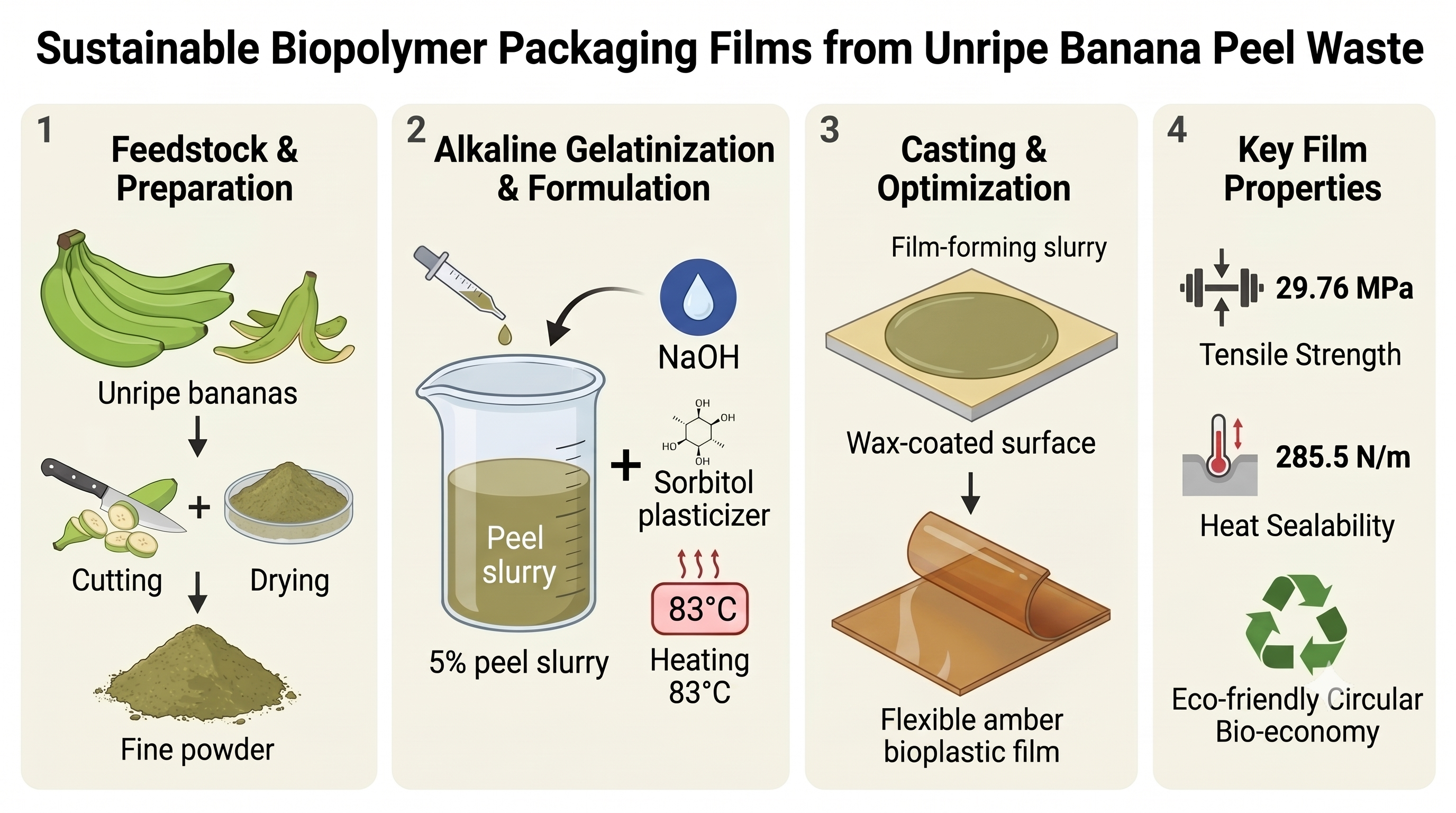
Petroleum-based synthetic plastics represent a major environmental and public health crisis due to their extreme persistence and resistance to natural biodegradation. To address this bottleneck, this study develops and optimizes a biopolymer packaging film directly derived from raw unripe banana peel powder, presenting a low-cost, waste-to-value circular pathway. Raw banana peels were processed into a fine powder to act as a self-reinforced starch-cellulose matrix. An alkaline-driven gelatinization process was performed using a sodium hydroxide solution to break down complex carbohydrates and increase slurry viscosity. Anton Paar Rheometer pasting analysis characterized the raw polymer’s gelation behavior, identifying a stable gel-forming capability. Glycerol and sorbitol were evaluated as plasticizers across diverse casting substrates. The formulation optimized with sorbitol and cast onto reusable, hydrophobic wax-coated surfaces exhibited superior mechanical strength, elasticity, and cohesive integrity, achieving clean, non-destructive de-molding. In contrast, glycerol-plasticized formulations suffered from high moisture retention, poor mechanical structure, and severe de-molding adhesion. Synthesizing these raw peel bioplastics bypasses costly starch-separation steps while naturally retaining bioactive, UV-blocking, and antioxidant compounds. The developed raw unripe banana peel film demonstrates promising physical and functional properties, representing a sustainable candidate to support the transition toward a circular bio-economy.
Downloads