
Global epidemiology and molecular virology of chikungunya virus: Two decades of resurgence, spread, and emerging control strategies (2004-2026)
DOI:
https://doi.org/10.5530/jam.5.3.11Keywords:
Chikungunya virus, Molecular virology, Genotype evolution, Mxra8 receptor, Global epidemiology, Arbovirus, Aedes albopictus, Aedes aegypti, E1-A226V, Vaccine safetyAbstract
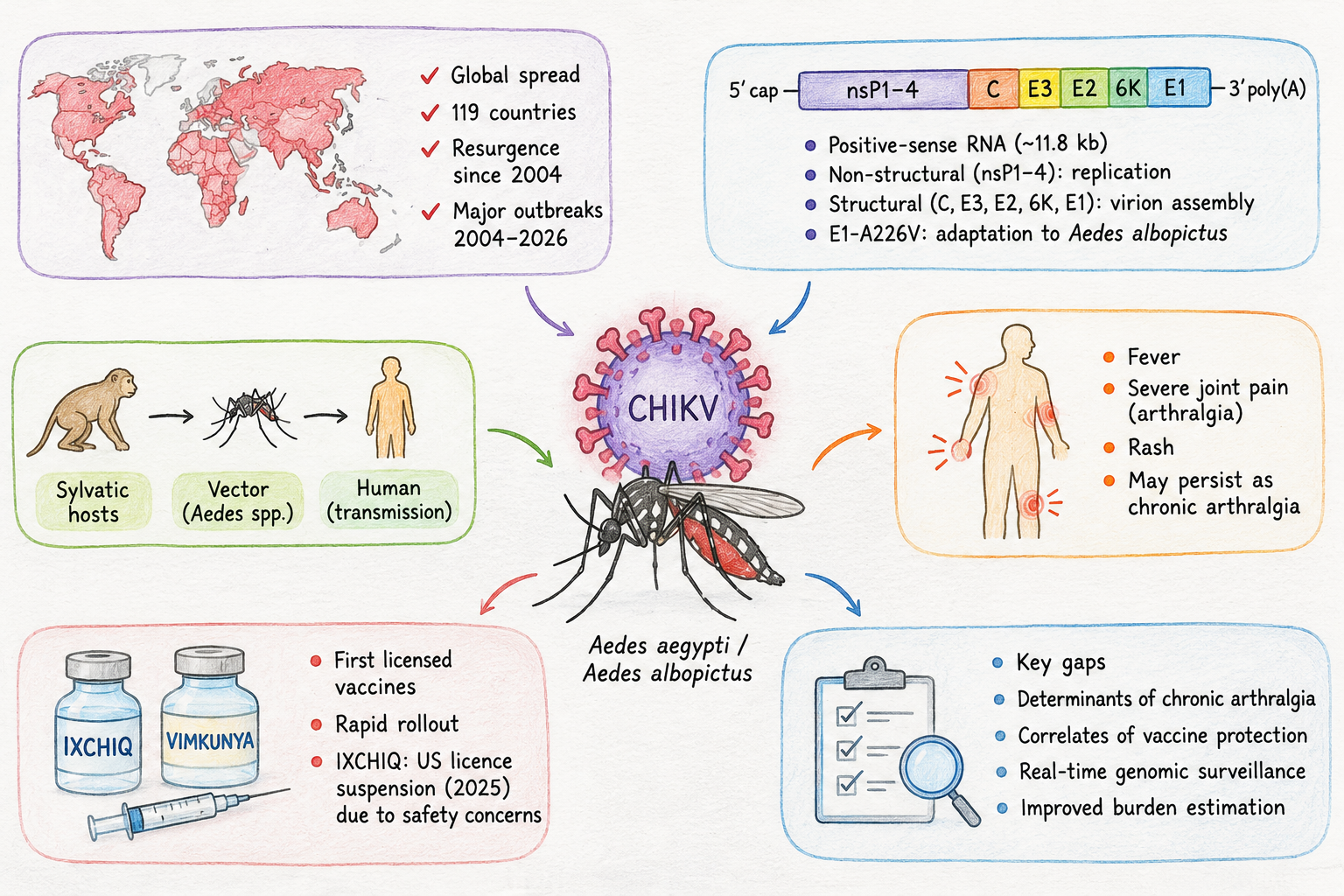
Chikungunya virus (CHIKV) is an Aedes-borne alphavirus of the family Togaviridae that has undergone one of the most dramatic geographic expansions of any arbovirus over the past two decades. Once regarded as a geographically confined, self-limiting febrile illness of East Africa and South Asia, CHIKV has, since 2004, established autochthonous transmission in at least 119 countries and territories across all six WHO regions, with modelled global incidence of autochthonous cases rising from an estimated 0.28 to 11.13 per 100,000 population between 2004 and 20241. This review synthesises two decades of peer-reviewed molecular-virological, phylogenetic and epidemiological literature, together with contemporary WHO, PAHO, ECDC and Africa CDC surveillance data, with two aims: first, to consolidate current understanding of CHIKV genome organisation, replication, receptor usage, genotype evolution and the molecular determinants of vector adaptation and pathogenicity; and second, to trace the virus’s regional epidemiological trajectories - the founding 2004-2006 East African and Indian Ocean epidemic and the E1-A226V substitution that adapted the virus to Aedes albopictus; explosive re-emergence and endemic settling across the Indian subcontinent and South/Southeast Asia; introduction into the Americas via the Caribbean in December 2013 and subsequent hemispheric spread; recurrent outbreaks across sub-Saharan and East Africa; progressively frequent autochthonous transmission in Europe since 2007, culminating in an unprecedented 2025 outbreak in mainland France linked to a major epidemic on Réunion Island; and the first large mainland Chinese outbreak (Guangdong, 2025). We further examine the environmental and socioeconomic factors associated with this resurgence - without inferring causation from ecological correlations - and critically appraise the rapid but troubled rollout of the first licensed chikungunya vaccines, IXCHIQ and VIMKUNYA, including the 2025 safety-related suspension of IXCHIQ’s US biologics licence. Persistent gaps in molecular surveillance, case confirmation and burden estimation continue to obscure the true scale of CHIKV disease, particularly in low-resource settings. We conclude by identifying the principal microbiological knowledge gaps - including incomplete understanding of the determinants of chronic arthralgia, the correlates of vaccine-induced protection, and the real-time genomic surveillance capacity needed to track further vector-adaptive evolution - that should guide the next phase of CHIKV research.
Downloads
Downloads
Additional Files
Published
Issue
Section
License
Copyright (c) 2026 Pradeep Kumar Singh, Shweta Kusmakar Singh (Author)

This work is licensed under a Creative Commons Attribution-NonCommercial-NoDerivatives 4.0 International License.