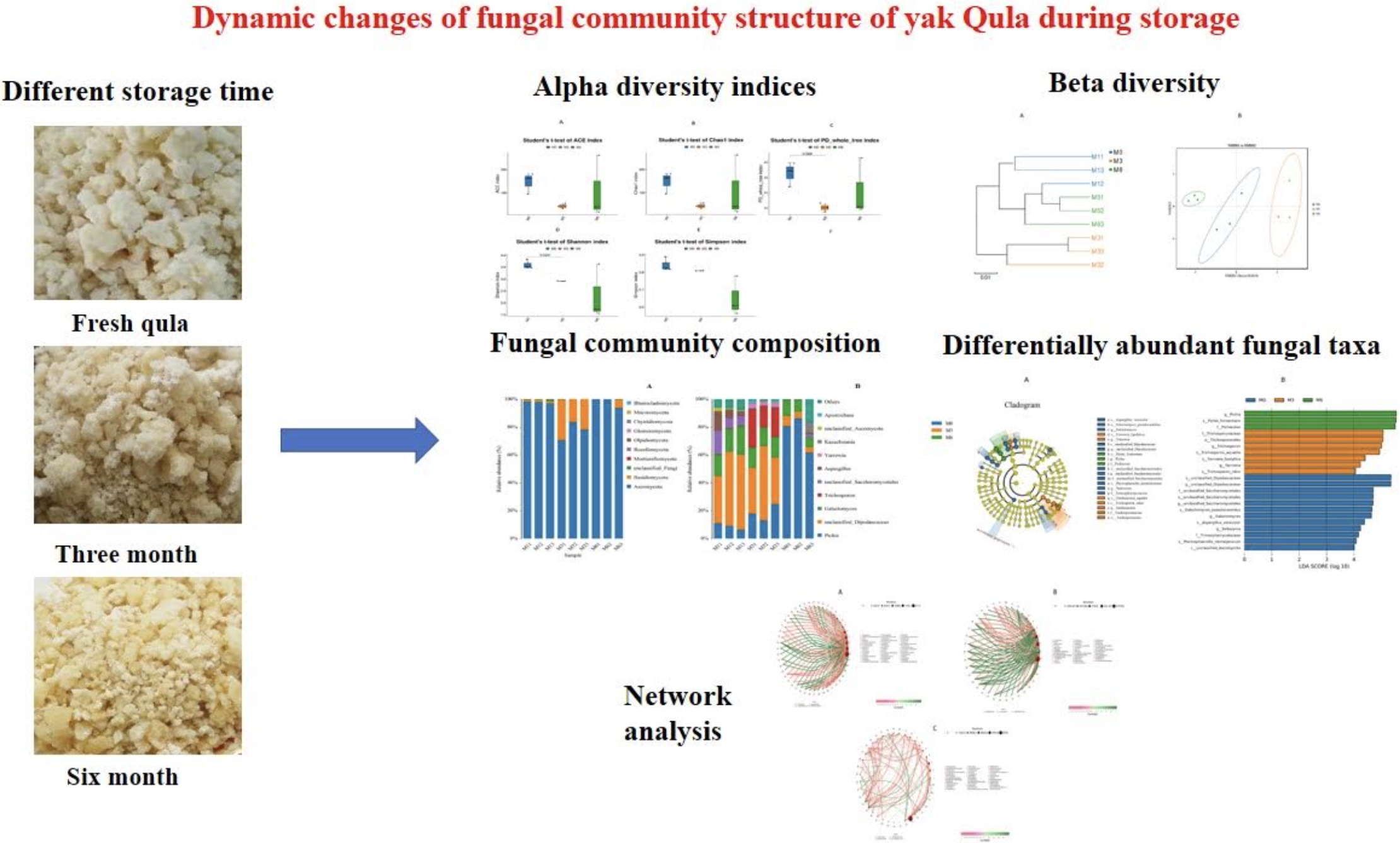
Dynamic changes of fungal community structure of yak Qula during storage
DOI:
https://doi.org/10.5530/jam.5.3.9Keywords:
Yak Qula, Fungal community, High-throughput sequencing, Dynamic successionAbstract
Yak Qula is a traditional fermented dairy product from the Tibetan Plateau, but the dynamic changes of its fungal community during storage remain poorly understood. This study employed Illumina MiSeq high-throughput sequencing to investigate the fungal community structure of yak Qula stored for 0 (fresh), 3, and 6 months. Results showed significant succession: at the phylum level, Ascomycota dominance (97.0%–98.2%) was temporarily replaced by increased Basidiomycota (16.2%–28.9%) at 3 months before recovering; at the genus level, fresh Qula dominated by unclassified Dipodascaceae and Galactomyces shifted to Trichosporon and Yarrowia at 3 months, and finally to absolute dominance of Pichia (61.8%–86.2%) at 6 months, with the Shannon index decreasing significantly (P = 0.026). LEfSe analysis identified potential safety concerns including the mycotoxin-producing Aspergillus versicolor (3 months) and the opportunistic pathogen Trichosporon inkin (6 months). SparCC network analysis revealed a dynamic succession of interaction patterns from "tight co-occurrence" to "bimodal mutual exclusion" to "polycentric loose" networks. These findings provide a scientific basis for quality evaluation, safety assessment, and storage optimization of Qula.
Downloads
Downloads
Additional Files
Published
Data Availability Statement
The sequencing data have been uploaded to the NCBI database.
Issue
Section
License
Copyright (c) 2026 Zhao Zhongjian, Zhang Yafeng, Wen Pengcheng, Zhang Zhongming, Zhang Weibing, Qiao Haijun (Author)

This work is licensed under a Creative Commons Attribution-NonCommercial-NoDerivatives 4.0 International License.